In This Article
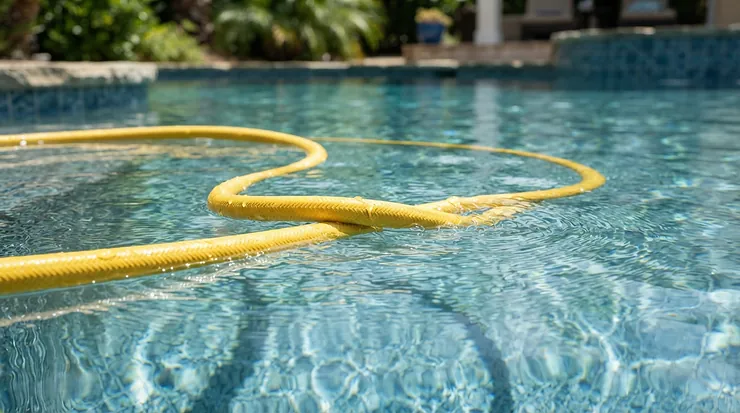
Cordless vs corded robotic pool cleaner for large inground pools is a choice between two power designs: battery-driven robots that swim free but stop when the charge runs out, and plug-in robots tethered by a floating cable that keep cleaning for as long as the outlet stays live.
Sounds simple. It isn’t. On a small pool, either type works, and the decision comes down to whether you hate cords or hate chargers. On a big pool, 40 feet or longer, with trees overhead and a deep end that drops like a cliff, the physics gets opinionated. A battery is a fuel tank. A cable is a leash. Which one runs out first is the entire story.
Here is what the 2026 research shows. Several independent testers still steer owners of very large pools toward corded models, citing unlimited runtime and steadier suction. Premium cordless robots, meanwhile, now claim four to five hours per charge and are closing the gap. Energy cost isn’t the tiebreaker either: a utility study cited by ENERGY STAR found a robotic cleaner drew only about 197 kWh a year, far less than pump-driven cleaners.
Settling the cordless vs corded robotic pool cleaner for large inground pools debate comes down to three details: cable length, the swivel power cable that keeps that cable from knotting, and what unlimited runtime means across a real season. This guide compares seven real robots, four corded and three cordless. Prices are ranges as of late 2026, review signals are aggregated rather than invented, and every spec comes from manufacturer or retailer listings. Let’s dive in. 🏊
Cordless vs Corded Robotic Pool Cleaner for Large Inground Pools at a Glance
| Factor | Corded Robot | Cordless Robot |
|---|---|---|
| Runtime | Unlimited runtime; 2-3 hour cycles are set by software, not a battery | Roughly 2.5-5 hours per charge, depending on model and mode |
| Reach on 50+ ft pools | 60-70 ft swivel power cable covers pools up to 50-60 ft | No cable limit, but the battery caps the area per charge |
| Handling | Heavier unit, caddy and cable to manage | Lighter, no cord, but needs charging and retrieval |
| Wear item | Cable and swivel eventually need replacing | Battery capacity fades over the years |
| Best For | Dolphin Premier, Polaris ALPHA iQ+, Polaris VRX iQ+ | Beatbot Sora 30, Aiper Scuba S1 Pro, WYBOT C1 |
Read this table as a spectrum, not a verdict. Corded robots win by default once a pool stretches past roughly 40-50 feet, because the cable and the outlet, not a battery, set the limits. Cordless models earn their keep when handling and storage matter more, but their rated areas (about 1,600 to 3,200 sq ft among the three here) are ceilings measured under ideal conditions, so treat them with healthy skepticism.
💬 Just one click — help others make better buying decisions too!😊
Top 7 Robotic Pool Cleaners for Large Inground Pools: Expert Analysis
Four plug-in robots, three battery-powered ones, and one honest verdict each. Specs come from manufacturer and retailer listings gathered in late 2026. Review signals are aggregated, not hand-tested, and prices are ranges that will drift.
1. Dolphin Nautilus CC Plus — easiest corded entry point
The Dolphin Nautilus CC Plus is the “plug in, drop in, walk away” robot that made corded cleaners mainstream. Retailer listings describe a 60 ft swivel power cable, a top-load cartridge filter, a cycle of roughly two to two-and-a-half hours, and a body around 19 lb. That weight matters: one person can lift it out of the water without a winch or an argument. The catch is the size rating. Listings range from 33 ft to 50 ft depending on who’s selling, and a spread that wide is a red flag for large pools, so confirm the manufacturer’s figure before you commit.
Based on the specs, the Dolphin Nautilus CC Plus suits a rectangular pool up to roughly 40 ft where you want corded consistency without premium pricing. Push it onto a 50 ft pool and a two-hour cycle starts to feel brisk. Waterline coverage also differs between listings, so check that too if scum lines are your enemy.
Owner-review volume for this exact variant was thin in the sources reviewed, so no rating is quoted. Several 2026 roundups do name it a top pick under $1,000, usually for simple, subscription-free operation.
Pros:
- ✅ Plug-and-play power, no battery to degrade
- ✅ 60 ft swivel power cable in the Wi-Fi bundle
- ✅ Lightweight body, easy single-person lift
Cons:
- ❌ Size rating varies by listing, from 33 to 50 ft
- ❌ Shorter cycle than premium corded models
Typically priced under $1,000, it is the safest corded value for mid-large pools.
2. Dolphin Premier — leaf-friendly three-hour cycle
When oak season arrives, the Dolphin Premier is the robot that shrugs. Maytronics lists the Premier’s specs: pools up to 50 ft, a 60 ft cable with an anti-tangle swivel, a default three-hour cycle, floor, wall and waterline coverage, a weekly timer, and a three-year warranty. Retailers also describe a leaf-bag filter option, which matters because a cartridge clogs while a roomy bag keeps suction alive through autumn.
The three-hour cycle is the spec to focus on. Fifty feet of pool at a robot’s crawl is a long commute, and extra minutes mean fewer missed corners. The trade-off is the missing app: scheduling is weekly-timer only, so you set it once and forget it.
On retail listings the Dolphin Premier sits near four stars from a few dozen ratings. Owners describe running the automatic three-hour cycle every two to three days to keep a pool spotless, and one owner of a roughly 29,000-gallon pool called it stellar. That is a small sample, so weigh it lightly.
Pros:
- ✅ Three-hour default cycle suits 50 ft pools
- ✅ Leaf-bag option for heavy debris
- ✅ Three-year warranty
Cons:
- ❌ No mobile app control
- ❌ Costs more than entry-level corded robots
Street prices run around $1,000-$1,100 in one 2026 guide, with list pricing higher, so check current price. The value is strong for leafy, large pools.
3. Polaris ALPHA iQ+ — 70 ft cable for 60 ft pools
Cable length is destiny on a big pool, and the Polaris ALPHA iQ+ brings the longer one: a 70 ft swivel power cable rated for in-ground pools up to 60 ft. That extra ten feet over the 60 ft class is your margin for awkward corners, deep ends and outlets that live nowhere convenient. It adds 4WD with a front brush for climbing, a 5-liter illuminated canister, and SMART, floor, floor-wall-waterline, waterline-only and custom modes. iAquaLink app control and a caddy are included.
SMART mode estimates cleaning time from the pool’s shape, size and surface, which means less guesswork and fewer under-cleaned corners. Polaris also states that its robots are ETL listed, a safety-certification mark worth noticing on any electrical gear that lives near water.
Verified owner-review data wasn’t available in the research, so no rating is claimed. What can be said is that the specs target large-pool owners and mirror the premium corded tier.
Pros:
- ✅ 70 ft swivel power cable for 60 ft pools
- ✅ 4WD climbing with a front brush
- ✅ Custom scheduling and multiple modes
Cons:
- ❌ Heavy, with a shipping weight past 40 lb
- ❌ Premium price tier
Dealer listings sit around $1,700, so check current price. It is best for 50-60 ft pools and tricky layouts.
4. Polaris VRX iQ+ — top-tier performance and reach
If large pools had a luxury sedan, it would be the Polaris VRX iQ+. Listings describe a 70 ft floating swivel power cable, coverage of floors, walls, steps and waterline, programmable cycles, iAquaLink control, and pools up to 60 ft. PCWorld’s review of the related Polaris VRX iQ rated its performance the best of any pool robot the outlet had tested. It also noted run time optimized to pool size and a lift system that retrieves the robot on demand without a pole. Pole-free retrieval is not a gimmick; it saves you from wrestling an 8-foot deep end.
The cost is real estate. Reviewers flag a large equipment footprint, meaning bigger caddy, bigger power supply, bigger storage corner. For a 30-footer that is overkill. For a 55 ft lap pool with a deep end it is a reasonable splurge.
Sentiment here is editorial rather than owner-based, and the praise comes from a test of the related Polaris VRX iQ, so verify that the iQ+ specs match before buying.
Pros:
- ✅ Strong tested performance in editorial review
- ✅ On-demand lift retrieval
- ✅ Run time tuned to pool size
Cons:
- ❌ Large equipment footprint
- ❌ Top-of-range pricing
Pricing sits in the premium corded tier, so check current price. The value is justified only if your pool is genuinely large or complex.
5. WYBOT C1 — cheapest serious cordless pick
Cordless on a budget, with one honest asterisk. The WYBOT C1 claims 150-160 minutes of runtime, a roughly four-hour recharge, 4-in-1 cleaning (floor, walls, waterline, steps), a triple-motor drive that climbs slopes up to about 45 degrees, app scheduling, and a rated area near 1,600 sq ft. In practice, 160 minutes of battery is a hard stop. A 20×40 ft pool (800 sq ft) fits comfortably; a 25×60 ft pool (1,500 sq ft) sits at the edge.
Based on the spec comparison, this is the right robot for a moderate pool that happens to be large-ish, and the wrong one for anything approaching estate scale. One 2026 roundup tells owners of very large pools to skip it, and that tracks with the numbers.
Aggregated sentiment hovers around four out of five stars, with roundups citing a deep owner history relative to rivals. Ratings vary by retailer, so read recent reviews on the listing you plan to use.
Pros:
- ✅ Lowest buy-in on this list
- ✅ No cable to manage
- ✅ App scheduling included
Cons:
- ❌ Roughly 2.5-hour battery caps large-pool coverage
- ❌ Rated area tops out near 1,600 sq ft
It runs around $430-$500, so check current price. It is fair value for moderate pools, but it is not a large-pool answer.
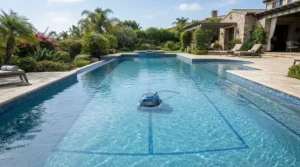
6. Aiper Scuba S1 Pro — Eco mode stretches runtime
The Aiper Scuba S1 Pro is the cordless robot that hands you a dial: more suction or more minutes. The 2024 edition quotes up to 180 minutes and coverage for pools up to about 2,150 sq ft. A 2026-edition write-up cites a 112 Wh battery with up to 270 minutes in Eco mode and 180 minutes in Auto, Floor or Wall modes. Its WavePath 2.0 navigation runs parallel lines instead of bouncing randomly, which is the difference between mowing a lawn in stripes and mowing it in a panic.
Eco’s longer runtime comes from reduced suction, so it suits lightly soiled large pools. For heavy debris, plan on the 180-minute modes and a pool in the 1,500-2,000 sq ft range, not the full rated ceiling.
An aggregator lists roughly 4.1 out of 5 across a few hundred reviews, which is solid but not a durability guarantee. Battery fade is the long-term unknown for any cordless unit.
Pros:
- ✅ Parallel-line navigation reduces missed strips
- ✅ Eco mode reaches up to 270 minutes
- ✅ Horizontal waterline cleaning
Cons:
- ❌ Eco trades suction for time
- ❌ Battery wear over several years
Earlier coverage put it around $1,000-$1,100, and discounts are common, so check current price. The value is fair for mid-large pools with moderate debris.
7. Beatbot Sora 30 — longest verified cordless runtime
The Beatbot Sora 30 is the cordless robot most likely to make a corded loyalist blink. Its 10,000 mAh battery delivers up to five hours of floor-only cleaning and about four and a half hours for combined floor, wall and waterline work, per manufacturer testing. Rated coverage is about 3,229 sq ft, with 6,800 GPH suction and a 5-liter basket. It weighs about 19.6 lb, cleans shallow platforms down to roughly 8 inches, and floats to the surface when finished, so you never fish it off the bottom.
Four and a half hours is enough for a 40-50 ft pool on one charge, on paper. Lab numbers are best-case, and heavy debris and wall-climbing drain faster. It does not skim the surface (its sibling the Sora 70 does), so tree-lined pools still need a skimmer.
The model is relatively new, and long-term durability data is thin. Beatbot’s own guide and some roundups call it a cordless value pick, but brand-hosted claims aren’t independent.
Pros:
- ✅ Up to five hours in floor mode
- ✅ Floats to the surface for easy retrieval
- ✅ 5L basket handles heavier loads
Cons:
- ❌ No surface skimming
- ❌ Long-term battery data still thin
Bundled with a skimmer it was listed near $1,300, so the standalone robot sits below that. Check current price. It is the best cordless shot at a large pool.
Top 7 Comparison
| Model | Power & Reach / Runtime | Rated Pool Size | Price Range | Review Signal | Best For |
|---|---|---|---|---|---|
| Dolphin Nautilus CC Plus | Corded, 60 ft swivel power cable | 33-50 ft (varies by listing) | Under about $1,000 | Editorial picks; thin owner data | Mid-large pools on a budget |
| Dolphin Premier | Corded, 60 ft cable, 3-hr cycle | Up to 50 ft | About $1,000-$1,100 street | About 4.0 retail (small sample) | Leafy 40-50 ft pools |
| Polaris ALPHA iQ+ | Corded, 70 ft cable | Up to 60 ft | Around $1,700 dealer | Not verified | 50-60 ft pools, tricky layouts |
| Polaris VRX iQ+ | Corded, 70 ft cable | Up to 60 ft | Premium tier | Editorial praise (related model) | Biggest or most complex pools |
| WYBOT C1 | Cordless, about 150-160 min | About 1,600 sq ft | About $430-$500 | About 4.0 aggregated | Moderate pools, tight budgets |
| Aiper Scuba S1 Pro | Cordless, 180-270 min | About 2,150 sq ft | About $1,000-$1,100 | About 4.1 aggregated | Light-to-moderate debris, 1,500-2,000 sq ft |
| Beatbot Sora 30 | Cordless, up to 5 hr | About 3,229 sq ft | Below about $1,300 | New; brand claims | Large pools wanting cordless |
The pattern is hard to miss: corded models are rated by pool length, cordless models by square footage, and that mismatch is why shoppers get confused. Convert your pool to both measures before comparing. The Polaris ALPHA iQ+ and Polaris VRX iQ+ buy you the most cable margin, while the Beatbot Sora 30 is the only cordless model here with a rated area that credibly covers a large pool.
✨ Don’t Miss These Exclusive Deals!
🔍 Take your pool maintenance to the next level with these carefully selected robots. Click on any highlighted item to check current pricing and availability. These picks will help you enjoy a clearer, cleaner pool all season long!
Setup Guide: Running a Corded Robot on a Large Pool Without Tangles
A big pool punishes lazy setup. Five habits cover most of it.
1. Plug into protected power. Use a GFCI-protected outlet and keep the power supply on dry deck, clear of splashes. The safety section below explains why.
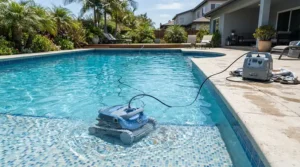
2. Respect the cable length rule. Manufacturer guidance for corded Dolphin models is to put in the water only roughly enough cable for the robot to reach the farthest corner. Extra slack invites loops and kinks. Hands-on reviews describe the same routine: drop the robot near the pool’s midpoint, feed out enough cable for the corners, and keep the rest coiled on deck.
3. Let the swivel power cable work. Lay the cable in a loose line rather than a pile, so the swivel can rotate freely as the robot turns. A swivel can only unwind what it can reach.
4. Run full cycles at first. One 2026 guide warns that a one-hour cycle on a 50 ft pool leaves corners dirty. Use the full cycle for the first few outings to learn what your robot misses.
5. Maintain it like a ritual. Rinse the filter after every use, empty the basket, check the brushes and keep the power supply dry. Before reeling the cable in, switch off and unplug.
The classic first-30-day mistakes are shortening cycles to save time, leaving the cable bunched in the water, and running the robot during a thunderstorm, which manufacturers advise against. Two or three runs a week is a commonly cited peak-season rhythm, though leafy pools often justify every other day.
Real-World Scenarios: Which Robot Fits Which Large Pool?
These are illustrative profiles, not customer stories, built from the specs above.
The oak-tree backyard. A 20×45 ft pool with a deep end, heavy leaf fall, and an outlet at the shallow end. Leaf-bag capacity and cycle length matter more than apps here, which points to the Dolphin Premier (60 ft cable, three-hour cycle). If the outlet sits at the far end of the deck, the extra reach of the Polaris ALPHA iQ+ is cheap insurance. Budget about $1,000-$1,700 and expect autumn runs every two or three days.
The long lap pool. A 15×55 ft rectangle. The corner-to-corner diagonal is about 57 ft before you add the deck run from the outlet, so a 60 ft cable is already stretched. This is the Polaris VRX iQ+ or Polaris ALPHA iQ+ territory, where a 70 ft cable and 60 ft pool rating leave breathing room.
The cord-hater. An 18×38 ft pool (about 684 sq ft) with light debris and an owner who would rather charge than coil. The Beatbot Sora 30 has enormous margin here, with a rated 3,229 sq ft against a 684 sq ft pool. If the budget is tight, the WYBOT C1 at around $430-$500 also clears the area comfortably. Plan on recharging after each cycle and running about three times a week.
The lesson: pool length and debris type pick the winner more often than brand loyalty does.
Buyer’s Decision Framework: If This, Choose That
Use this as a quick filter, then verify specs on the listing you plan to buy from.
- If your pool is longer than about 50 ft, choose a 70 ft corded model like the Polaris ALPHA iQ+ or Polaris VRX iQ+, because cable length margin matters more than any app feature.
- If leaves and heavy debris dominate, choose the Dolphin Premier, because corded suction doesn’t fade as a battery drains and the leaf-bag option copes with volume.
- If you refuse to manage a cable and your pool is under about 2,000 sq ft, choose a premium cordless like the Beatbot Sora 30, because it has runtime to spare.
- If your budget is under $500 and the pool is moderate, choose the WYBOT C1, because it is the cheapest serious cordless option.
- If you want corded power under $1,000 and the pool is 40 ft or less, choose the Dolphin Nautilus CC Plus, because it is simple and light.
Priority checklist: 1) pool length and diagonal, 2) debris type, 3) distance from outlet to pool, 4) handling tolerance, 5) budget. Answer them in that order and the shortlist usually writes itself.
How to Choose Between a Cordless vs Corded Robotic Pool Cleaner for Large Inground Pools
- Measure length and diagonal. Corded ratings are in feet, so know your longest run, not just surface area.
- Convert to square feet and gallons. Cordless ratings are in sq ft. Some corded-leaning guides put the corded threshold near 25,000-30,000 gallons or 2,000 sq ft, though that sits near the cordless camp’s own sales interest, so treat it as a rule of thumb.
- Match cable length to the outlet. Add the deck run from outlet to water edge to the pool diagonal. If you are over 60 ft total, shop 70 ft cables.
- Match debris load to filter design. Sand and dust favor fine filters; leaves favor bags or large canisters.
- Read runtime for your mode. A headline “270 minutes” may be Eco mode, while full floor, wall and waterline work can be notably shorter.
- Check warranty and certification. Warranties in the listings reviewed ranged from one to three years, and ETL or UL marks are worth looking for on electrical gear.
- Be honest about handling. If you won’t lug a 40 lb robot and caddy, a corded model will gather dust in the shed.
Corded Robotic Pool Cleaner for Long Pool Coverage: Why Cable Length Decides Everything
A corded robotic pool cleaner for long pool coverage lives or dies by cable length. The pattern in the listings is neat: a 60 ft cable is rated for pools up to 50 ft, and a 70 ft cable for pools up to 60 ft. The rule of thumb is cable length ≈ pool length + 10 ft, and that extra ten feet is not generosity. It is the allowance for the diagonal, the walls, and the path back to the outlet.
Run the math on a 50 ft by 20 ft pool with an 8 ft deep end. The straight-line distance from one corner to the opposite corner, including depth, is about 54 ft. Add the deck run to the outlet and a 60 ft cable has almost no slack left. That’s why the cable length of the Polaris ALPHA iQ+ and Polaris VRX iQ+ isn’t a marketing flourish for long pools.
One practical trick: put the power supply near the middle of a long side rather than at an end, so the cable only needs to span half the pool in either direction. It is free and it works.
Need more than 70 ft? Commercial Dolphin models list cables of 131 ft and 165 ft, but those are commercial-class machines with commercial price tags. For residential pools, the effective ceiling is 70 ft, and a retailer specialist confirmed that the longest cable offered for one 60 ft Dolphin model was 60 ft.
Corded Pool Robot for Continuous Cleaning Cycles: What Unlimited Runtime Really Means
A corded pool robot for continuous cleaning cycles has a quiet superpower: unlimited runtime. The cycle length, often two to three hours, is set by software, not by a battery’s mood. Finish a cycle, empty the filter, and run another immediately. A cordless model must wait through a recharge that listings put around three to four hours for popular models.
That matters most for post-storm cleanups and heavy-use summers. A corded robot can do two back-to-back cycles on a debris-strewn pool the same afternoon. A cordless robot, even a long-runtime one like the Beatbot Sora 30, becomes a one-cycle-a-day proposition.
A caveat keeps the claim honest. Unlimited runtime doesn’t mean the robot should live in the pool permanently. Manufacturers generally don’t recommend leaving robots in the water around the clock, and the filter fills long before the power does. Think “back-to-back cycles when needed,” not “perpetual motion.”
Energy is the pleasant surprise. A Dolphin listing claims about five cents per hour of operation, roughly 15 cents for a typical 2.5-hour cycle. That is a manufacturer claim, but it fits the low-draw picture from the utility study noted earlier, where a robotic cleaner used about 197 kWh a year.
Swivel Power Cable: What It Fixes and What It Doesn’t
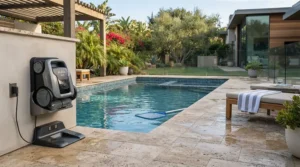
The swivel power cable is the unsung hero of corded robots. It’s a rotating joint at the robot end of the floating cable that lets the robot turn without winding the cable into a pretzel. Manufacturers use cautious wording like “tangle-reducing” and “anti-tangle,” not “tangle-proof,” and that wording is accurate.
What it fixes: twisting. Robots turn constantly, and without a swivel the cable accumulates torque until it knots or tugs the robot off course. What it doesn’t fix: loops created by too much cable in the water, snags on ladders, and kinks from sitting coiled for months. The cable length rule from the setup guide still applies.
It is also a wear part. Replacement swivel cables are model-specific, and parts listings show prices ranging from roughly $180 to $350 depending on wire count and model. Compatibility is fussy: Nautilus CC Plus Wi-Fi and non-Wi-Fi versions use different cables, and basic Nautilus CC models have no swivel option at all per one retailer’s specialists. Before buying a replacement, match the part number to your exact model. A 3-wire cable won’t rescue a 2-wire robot.
For large pools, the swivel power cable is the single most important mechanical detail. It’s not glamorous, but it’s the reason a 60 ft cable works on a 50 ft pool.
Cordless vs Corded Robotic Pool Cleaner for Large Inground Pools vs Traditional Cleaners
| Factor | Corded Robot | Cordless Robot | Suction-Side / Pressure-Side |
|---|---|---|---|
| Power source | Own low-voltage supply via GFCI outlet | Rechargeable battery | Runs off the pool pump; pressure-side may need a booster pump |
| Energy use | About 197 kWh/yr in one utility study | Low; battery charging only | 1,675-2,989 kWh/yr in cited study |
| Large-pool coverage | Cable and outlet set the limit | Battery sets the limit | Depends on hose reach and pump capacity |
| Setup | Plug in, manage cable | Charge, drop, retrieve | Install hoses and wall fittings |
| Best For | Polaris ALPHA iQ+, Dolphin Premier | Beatbot Sora 30 | Debris-heavy pools with existing pump infrastructure |
Robots win on energy because they bring their own low-voltage power instead of making a pump work at high flow. Between the two robot types, corded wins on guaranteed coverage and cordless wins on convenience. Traditional cleaners stay relevant mainly for debris-heavy pools that already have the plumbing and pump capacity for them.
Long-Term Cost & Maintenance: Batteries vs Cables
Total cost of ownership is closer than sticker prices suggest. Corded robots have no battery to age, but their cable and swivel eventually wear, with replacements running roughly $180-$350 per parts listings. Cordless robots avoid cable wear, yet one source puts battery replacement at about four to five years, a lithium-ion reality that no brand can fully engineer away.
Warranties differ more than you’d expect. The Dolphin Premier lists three years, listings for the Dolphin Nautilus CC Plus range from one to two-and-a-half years depending on seller, and the Aiper Scuba S1 Pro has been sold with a two-year product care plan. Read the warranty on the exact retailer listing, because third-party sellers sometimes differ.
Running costs are small either way. At about five cents an hour for a Dolphin-class robot, a season of cycles costs less than a couple of cleaning-chemical refills. The expensive mistakes are different: buying a robot too small for the pool and running it twice as often, or tossing a clogged filter into a pool that needed a leaf bag.
Maintenance is minimal but not zero: rinse filters, check brushes, and store the robot out of direct sun. Neglect is what actually shortens a robot’s life, not the power type.
Safety First: GFCI Protection and Electrical Basics for Corded Robots
Water and electricity are a classic bad pairing, so corded robots deserve a few boring but important habits. The U.S. Consumer Product Safety Commission has long recommended ground-fault circuit interrupter protection around pools, and its guidance on electrical hazards around pools walks through the TEST and RESET button check on a GFCI. If the test doesn’t cut the power, the device needs replacing or inspection.
Practical rules follow. Plug the robot’s power supply into a GFCI-protected outlet, keep the supply on dry deck, switch off and unplug before touching the cable, and don’t run the robot during lightning. Older pools may lack adequate GFCI protection on their circuits, which is worth an electrician’s visit.
Look for certification marks too. Polaris states that its robotic cleaners are ETL listed, and certification matters for cordless units as well, since lithium batteries and chargers live near water. Whichever power type you choose, the safest robot is one installed and charged the way its manual says.
FAQ
❓ Is a cordless pool robot worth it for a 40-foot pool?
❓ What cable length do I need for a 50 foot inground pool?
❓ How often does a swivel power cable need replacing?
❓ How much electricity does a corded pool robot use per cycle?
❓ How long do cordless pool robot batteries last?
Conclusion
So which wins the cordless vs corded robotic pool cleaner for large inground pools showdown? Past roughly 40-50 feet, corded still holds the safer position. Unlimited runtime, a 60-70 ft swivel power cable, and steady suction mean a corded robot is limited by your outlet, not a battery gauge. The Dolphin Premier suits leafy pools, the Polaris ALPHA iQ+ and Polaris VRX iQ+ buy cable length for 50-60 ft pools, and the Dolphin Nautilus CC Plus is the budget corded door-opener for pools up to about 40 ft.
Cordless has earned a seat at the table, though. The Beatbot Sora 30 and Aiper Scuba S1 Pro show that premium batteries can handle big pools if you accept a recharge ritual and a younger durability record, while the WYBOT C1 keeps cordless affordable for moderate pools.
The deciding questions are boring and decisive: pool length and diagonal, debris load, outlet distance, and how much you tolerate lugging a cable. Answer those, verify specs on the exact listing, and you’ll land on the right robot without needing a miracle.
Recommended for You
- Cordless Robotic Pool Cleaner for Above Ground Pool Ladder Entry 2026
- Robotic Pool Cleaner for Pools With Heavy Leaf Debris: 7 Best 2026
- Robotic Pool Cleaner for Pets with Hair in the Pool: 7 Best Buys 2026
Disclaimer: This article contains affiliate links. As an Amazon Associate, I earn from qualifying purchases. If you purchase products through these links, we may earn a small commission at no additional cost to you.
✨ Found this helpful? Share it with your friends! 💬🤗
