In This Article
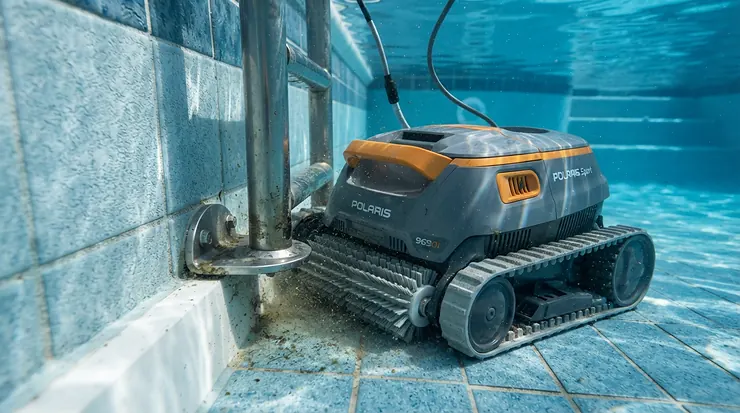
Picture it: a corded robot lumbers across your above ground pool, sniffs out the ladder, and wraps its tail around the legs like a toddler with a kite string. That’s the problem a cordless robotic pool cleaner for above ground pool ladder entry is built to solve.
What is a cordless robotic pool cleaner for above ground pool ladder entry? It’s a battery-powered, self-propelled pool vacuum that cleans the floor (and sometimes walls and waterline) of a soft-sided or steel-wall pool without a power cable. With no tether to snag, it can work around ladder legs and entry steps without tangling.
I spent this research pass digging through manufacturer specs, retailer listings, and independent roundups from 2026. One thing needs saying up front: no brand I found publishes ladder-specific testing. So this guide treats the ladder as a real-world constraint and reasons through it from specs and reviewer reports. Where the evidence runs thin, I’ll say so.
The category itself is well established, but cordless models add a twist: lithium battery runtime, charging logistics, and how you pull a wet robot out of the water. We’ll cover all of it, including the cordless pool robot for pools with ladder setups most listings ignore.
Quick Comparison: Top 7 Cordless Picks at a Glance
| Product | Runtime (listed) | Best For |
|---|---|---|
| Beatbot AquaSense 2 | About 4 hours | Premium buyers wanting waterline cleaning and low babysitting |
| Dolphin Liberty 400 | 1.5-2.5 hours (varies by source) | Brand-loyal buyers wanting inductive charging |
| Wybot C2 | 120-180 minutes | Mid-range shoppers wanting app control |
| Aiper Seagull Plus | Not verified | Above-ground-specific mid-budget buyers |
| Aiper Scuba SE | Up to 90 minutes | Small, flat-bottom pools on a budget |
| AIRROBO CP02 | About 120 minutes | Ultra-budget small pools |
| PoolMr Cordless Robotic Pool Cleaner | About 120 minutes | Value seekers wanting dual cleaning |
Here’s what the table doesn’t say out loud. Runtime is the headline number, but price and cleaning coverage separate these robots more sharply. The Beatbot AquaSense 2 and Dolphin Liberty 400 cost several times what the Aiper Scuba SE or AIRROBO CP02 do, and the extra money buys waterline work and polish, not magically cleaner floors. If your pool is small and flat, the budget tier deserves a serious look.
💬 Just one click — help others make better buying decisions too!😊
Top 7 Cordless Robotic Pool Cleaners for Above Ground Pools: Expert Analysis
1. Beatbot AquaSense 2 — longest runtime, waterline included
The Beatbot AquaSense 2 is the premium end of this list. It packs a roughly 10,000 mAh non-removable battery, a 200W brushless pump, and listed suction around 5,500 GPH. That matters because strong suction plus a long cycle (about four hours per the maker) means fewer mid-week rescue missions to the charger.
Based on the spec comparison, it’s the pick for larger or leafy pools, and it handles floors, walls, and waterline. Weight sits around 23 lbs, so the “easy lift out” part leans on its surface-parking feature rather than raw lightness. On a ladder-equipped pool, parking near the wall beats fishing with a hook.
Reviewers in one 2026 roundup rated it about 4.6 out of 5. One independent tester who generally prefers corded robots still named the Beatbot line the top battery pick, which tells you something about where cordless currently peaks.
Pros:
- ✅ Longest listed runtime in this lineup
- ✅ Cleans floor, walls, and waterline
- ✅ Parks at the surface for easy retrieval
Cons:
- ❌ Premium pricing for a flat-floor pool
- ❌ Heavy to lift when removed
Price range: roughly $800-$1,300 depending on promotions. Verdict: overkill for a basic 15-footer, a great fit for big, messy pools.
2. Dolphin Liberty 400 — inductive charging, familiar brand
The Dolphin Liberty 400 is Maytronics’ cordless entry, listed for both in-ground and above-ground pools up to roughly 10 x 5 meters. Instead of a plug-in port, it charges inductively, so you snap it onto a charger rather than fiddle with wet connectors. At about 17.9 lbs (8.1 kg), it’s noticeably lighter than the Beatbot.
Here’s where sources disagree, and I’d rather flag it than guess. One brochure lists a 1.5-hour cycle, while a manufacturer page lists a 2.5-hour default. Its “Eco Mode” runs short cycles to keep a pool clean across a week. Coverage claims also vary: an expert review notes limited waterline and filtration, while the brochure advertises waterline cleaning. Confirm on the listing before buying.
Customer review data is thin. One retailer page showed only two reviews, one noting it’s convenient but short on battery life. The expert review at one retailer scored coverage, ease of use, and warranty highly (the warranty term is listed as two or three years, so verify).
Pros:
- ✅ Inductive charging avoids wet connector fuss
- ✅ Lighter than the premium Beatbot
- ✅ Established brand with strong warranty
Cons:
- ❌ Limited waterline and filtration per one review
- ❌ Conflicting runtime figures across sources
Price range: around $1,000-$1,100 list. Verdict: pay for the brand and charging convenience, not for runtime.
3. Wybot C2 — app control and dual-layer filtration
The Wybot C2 sits in the sweet middle: cordless, app-controlled, with dual-layer (coarse plus fine) filtration and over-the-air updates per listings. Runtime is where retailers disagree: some list up to 180 minutes in floor mode, others quote 120 minutes. Treat 120 minutes as the safe planning number.
On paper this means the C2 can handle a medium above ground pool in a single run, with the fine filter picking up silt that basic baskets let slip back into the water. Listings cite coverage up to roughly 1,614 sq ft and a 2-year warranty.
One independent tester picked it as their cordless favorite for above ground pools. Another, who generally prefers corded robots, called out the recharge routine as “more babysitting than automation.” A retailer listing showed a modest mid-3-star average on a small sample of ratings, so expect mixed experiences.
Pros:
- ✅ App control with scheduling options
- ✅ Dual-layer filtration catches fine debris
- ✅ Covers floor, walls, and waterline per listings
Cons:
- ❌ Runtime claims vary between retailers
- ❌ Frequent recharging irritates some reviewers
Price range: roughly $400-$700 across versions I found. Verdict: solid mid-tier value if you’ll actually use the app.
4. Aiper Seagull Plus — built specifically for above ground
The Aiper Seagull Plus is marketed explicitly as a cordless above ground robotic cleaner, which already puts it ahead of models that treat above-ground as an afterthought. One retailer lists a 2.5-hour charge time.
I couldn’t verify its runtime or suction in my research, so I won’t pretend otherwise. What I can say is that the Plus sits above the entry-level Aiper models and below Aiper’s in-ground flagships, a sensible slot for a soft-liner pool owner who wants more than a bargain-bin bot.
Review sentiment for the Plus specifically wasn’t verifiable. For context, Aiper’s closely related entry model, the Seagull SE, drew praise in one roundup for light weight and simple cordless operation, and criticism for no wall climbing and a small debris basket. Those traits likely echo here, but treat that as a hint, not a promise.
Pros:
- ✅ Explicitly designed for above-ground pools
- ✅ Plug-and-play operation: submerge and go
- ✅ Positioned mid-budget between entry and flagship
Cons:
- ❌ Key specs unverified in my research
- ❌ Likely small debris basket, going by its sibling
Price range: roughly $290-$400 at the retailers I found. Verdict: reasonable if the full specs check out against your pool size.
5. Aiper Scuba SE — cheap, flat-floor specialist
The Aiper Scuba SE is for small, flat-bottom pools, and it knows its lane. Listings put it at up to roughly 850-860 sq ft, with a runtime of up to 90 minutes, an audio alert, and auto-parking.
A 90-minute cycle works when the pool is small and flat, because above-ground floors have no deep end and no complex steps to navigate. The catch is that budget runtime leaves little margin if your pool is leafy or you have a large footprint.
I couldn’t pull a clean, product-specific review aggregate, so I’m not quoting ratings. What retailers show is strong sales volume, which is demand, not satisfaction.
Pros:
- ✅ Affordable entry into cordless cleaning
- ✅ Auto-parking and audio alert for retrieval
- ✅ Suited to flat above-ground floors
Cons:
- ❌ 90-minute listed runtime limits big pools
- ❌ Floor-focused; not for waterline grime
Price range: roughly $150-$200. Verdict: a smart pick for a small pool; skip it if you have heavy debris.
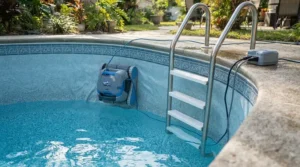
6. AIRROBO CP02 — rock-bottom price, 120-minute runtime
The AIRROBO CP02 targets small above ground and in-ground pools with a listed 120-minute runtime, which matches mid-tier robots at a fraction of the price. For a compact pool with a ladder and mostly dust and light leaves, 120 minutes is plenty.
Its trade-off is predictable at this price: a basic navigation setup and unverified long-term durability. I couldn’t verify review sentiment for the CP02 independently, so I’m not claiming any. Retailer listings show high purchase volume and steep discounts off the original list price, which suggests it’s priced to move.
If you pick this one, treat it as a seasonal tool: run it, rinse the filter, store it dry. It’s the choice for someone whose pool is small enough that even a mediocre robot beats a hand vacuum.
Pros:
- ✅ Mid-tier runtime at budget pricing
- ✅ Light enough for easy handling
- ✅ Fits small above-ground and in-ground pools
Cons:
- ❌ Independent review data scarce
- ❌ Likely basic navigation at this price
Price range: roughly $100-$220 depending on discounts. Verdict: good risk-adjusted value for tiny pools.
7. PoolMr Cordless Robotic Pool Cleaner — dual cleaning at a value price
The PoolMr Cordless Robotic Pool Cleaner lists 40W suction, a dual cleaning system, and a 120-minute runtime for above ground pools. One 2026 above-ground roundup named it best overall for its balance of power, convenience, and affordability.
Here’s what that means in practice: 40W isn’t flagship suction, but above-ground floors tend to collect leaves and light dirt rather than heavy sediment, so modest suction can be enough. The dual system is the interesting part, since two cleaning actions often catch more than a single brush.
I couldn’t verify a current price range for this exact model, so check the listing. Comparable 120-minute models in my research landed roughly in the $100-$150 band, which is a ballpark, not a quote.
Pros:
- ✅ Dual cleaning system for better pickup
- ✅ 120-minute listed runtime
- ✅ Tailored to above-ground pools
Cons:
- ❌ Modest 40W suction
- ❌ Price and review depth hard to verify
Price range: check current price; likely budget-tier. Verdict: promising if the price lands near comparable models.
How to Choose a Cordless Robotic Pool Cleaner for Above Ground Pool Ladder Entry
- Match runtime to pool size. A 90-minute robot is fine for a small flat pool; a large oval wants 120 minutes or more.
- Confirm above-ground compatibility. One review noted that Aiper rates its Scuba V3 for in-ground use, so a premium label doesn’t guarantee a soft-liner fit.
- Check the lift-out method. Handle, hook, or surface parking: pick the one you’ll use daily.
- Weigh filtration. Fine filters help with silt; basic baskets suit leaves.
- Think about the ladder. A ladder with in-pool legs means obstacles; a hang-on style leaves more floor clear.
- Budget for batteries. Lithium cells wear, so a longer warranty has real value.
- Verify real reviews. Favor independent testing over listing copy.
Lithium Battery Runtime: What the Numbers Actually Mean
Runtime is the most abused number in this category. Brands list the best case (eco mode, floor-only, clean water) while owners live in the real case.
A lithium-ion battery delivers high energy for its weight, which is why cordless robots are viable at all. But capacity fades with cycles, heat, and deep discharge. A robot that lists 120 minutes new may deliver less after a couple of seasons.
Here’s how I’d translate it. For a pool under about 400 sq ft with light debris, 90 to 120 minutes of lithium battery runtime covers a full pass. For larger pools or heavy leaf fall, 150 minutes and up is the safer territory, and the Beatbot AquaSense 2 is the one on this list that clearly plays there. Also note that charging time counts: the Aiper Seagull Plus lists a 2.5-hour charge, so it won’t run daily without planning.
Practical tip: don’t judge battery performance in week one. Judge it after a month of weekly cycles, then compare to the listed figure.
No Cable Tangling: What Cordless Really Fixes
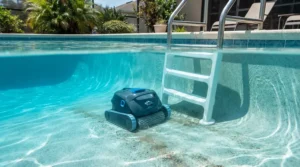
The headline promise of no cable tangling is real, and for ladder pools it’s the biggest practical win. A corded robot drags a floating cable that loops around ladder legs, pool skimmers, and return jets. A cordless unit leaves all that behind.
But let’s be honest about what cordless doesn’t fix. It doesn’t remove obstacles; it just removes the rope. A battery robot can still bump the ladder, stall against a step, or park in an awkward spot. Cordless trades tangling for battery management.
One independent tester who still prefers corded robots argues that recharging daily is the cost of the cordless dream. That’s a fair counterpoint, and it’s why pool size and debris load matter so much to the decision. For a small, tidy above ground pool with a ladder, I’d say the tangle-free trade is worth it. For a big, leaf-heavy one, it’s closer to a coin flip.
Easy Lift Out Handle: The Feature Nobody Counts Until It’s Missing
You’ll lift the robot out of the water more often than you think, and above-ground walls make that harder than inground coping does. You’re reaching over a wall, sometimes on a deck, sometimes from a ladder platform.
An easy lift out handle matters because a waterlogged robot is heavier than its dry weight suggests. The Dolphin Liberty 400 (about 17.9 lbs dry) and Beatbot AquaSense 2 (about 23 lbs) are the weightier options, so look at how each is retrieved. The Beatbot AquaSense 2 parks at the surface, while the Aiper Scuba SE lists auto-parking and an audio alert, and many models ship with a retrieval hook.
My take: a handle is great, surface parking is better, and a hook alone is the bare minimum. If you’re older or have limited upper-body strength, prioritize the lighter robots or surface parking over raw runtime.
Cordless Pool Robot for Pools With Ladder: A Setup Guide
This is the transformation piece most listings skip. A ladder changes how you should set up and run a battery robot.
Before the first run:
- Check whether your ladder is an A-frame with in-pool legs or a hang-on type.
- Safety guidance for above ground pools generally recommends securing or removing the ladder when the pool isn’t in use; see Pool Safely’s guidance for the current recommendations.
- Lift or swing out any removable ladder section before launching the robot.
During the first 30 days:
- Run one short cycle and watch where the robot snags.
- Note whether it parks near the ladder; if so, change the start position.
- Check the filter after each run, since cordless motors weaken when basket flow is blocked.
Common ladder mistakes:
- Launching the robot next to the ladder legs.
- Leaving the ladder in a position that traps the robot in a corner.
- Forgetting to charge the battery before the weekend.
The whole routine takes about five minutes, and it prevents most of the stuck-robot rescues.
Battery Powered Robotic Cleaner for Above Ground Pool: Real-World Performance
A battery powered robotic cleaner for above ground pool use faces different conditions than an in-ground one. The floor is flat, the walls are soft or steel, and there’s usually no deep end. That’s easier for navigation and harder for climbing, which is why several budget models skip wall climbing entirely.
The takeaway is simple. For flat above-ground floors, a basic robot with a decent filter does 90 percent of the job. Where extra money pays off is waterline work and long runtime, both of which the Beatbot AquaSense 2 handles better than the entry tier.
Also consider your pool surface. Vinyl liners need gentle tracks and brushes, and manufacturer specs for the Wybot C2 list compatibility across vinyl and other surfaces. When in doubt, read the surface compatibility line, not the marketing banner.
Cordless vs Corded Pool Robots: What You Gain and Lose
| Factor | Cordless (e.g., Wybot C2, Beatbot AquaSense 2) | Corded (traditional) |
|---|---|---|
| Tangling risk | None | Cable can wrap ladders and jets |
| Runtime | 90-240 minutes, battery-limited | Full cycle, no limit |
| Setup | Drop in and go | Power supply and cable management |
| Lifting | Battery weight; handle matters | Cable aids retrieval |
| Best For | Small to medium pools with ladders | Large, leafy pools |
Looking at the comparison, cordless wins on convenience and loses on endurance. An independent tester who has run dozens of robots remains skeptical of cordless for heavy-duty pools, and that caution is reasonable. For the typical above ground pool, though, the tangle-free setup is a genuine upgrade. Match the choice to your pool’s debris load.
Price Range and Value Analysis
| Tier | Products | Typical Range | Best For |
|---|---|---|---|
| Budget | Aiper Scuba SE, AIRROBO CP02, PoolMr Cordless Robotic Pool Cleaner | $100-$220 | Small, flat pools |
| Mid-range | Wybot C2, Aiper Seagull Plus | $290-$700 | Medium pools wanting app control |
| Premium | Beatbot AquaSense 2, Dolphin Liberty 400 | $800-$1,300 | Larger pools, waterline needs |
The budget tier delivers the best cost-per-clean for small pools, while the premium tier pays off only if you use the waterline cleaning and longer runtime. If you clean weekly for a 20-week season, a $150 robot costs well under $10 per season of use, which is hard to beat. The Wybot C2 and Aiper Seagull Plus are the sensible middle for owners who want more reliability without flagship pricing.
Real-World Scenarios: Which Robot Fits Which Pool
Scenario 1: The 15-foot round pool with a ladder. You have a small, flat pool, light debris, and a budget of about $200. The Aiper Scuba SE or AIRROBO CP02 fits, because 90 to 120 minutes covers the floor and the ladder legs are the only obstacle.
Scenario 2: The 24-foot pool under oak trees. Leaves arrive daily. The Beatbot AquaSense 2 earns its price here, thanks to long runtime, waterline cleaning, and larger filtration. A basic robot would fill its basket in a single pass.
Scenario 3: The family pool with kids and sunscreen. Oils and fine dirt build at the waterline. The Wybot C2 with fine filtration or the Beatbot AquaSense 2 make sense, and the app scheduling means the robot runs overnight.
Scenario 4: The weekend-only owner. You open the pool Friday and close it Sunday. A lightweight, cheap robot like the PoolMr Cordless Robotic Pool Cleaner works, because battery wear matters less with light use.
Problem and Solution Guide: Fixing Common Cordless Robot Headaches
Problem: The robot dies mid-pool. Solution: Shorten the cycle or switch to an eco mode, and charge fully before each run.
Problem: It keeps bumping the ladder. Solution: Relocate the start point, swing up or remove the ladder section, and consider a robot with obstacle sensing like the Wybot C2.
Problem: Weak suction after a few runs. Solution: Rinse the filter, since clogged baskets sap performance more than weak motors do.
Problem: Hard to lift out. Solution: Use the hook, or choose surface parking like the Beatbot AquaSense 2.
Problem: The battery seems to fade. Solution: Avoid storing it fully drained or in direct heat, and rotate use evenly across the season.
Common Mistakes When Buying a Cordless Robot for an Above Ground Pool
The biggest mistake is buying an in-ground robot for an above ground pool. Soft liners, flat floors, and steel walls behave differently, and one review explicitly noted a flagship cordless model rated for in-ground use only.
The second mistake is trusting the runtime number. Listings give best-case figures, and as we saw with the Wybot C2, retailers don’t even agree with each other.
Third, ignoring the lift-out. A heavy robot over a tall wall is a back strain waiting to happen. Fourth, assuming “cordless” means “maintenance-free.” It means battery management instead of cable management.
Last, skipping the ladder question. If your ladder sits in the pool, plan the robot’s path around it, not through it.
Long-Term Cost and Maintenance
A cordless robot is cheap to run and not free to own. The real costs are battery wear, filters, and brushes.
Lithium batteries typically lose capacity gradually, so a longer warranty is meaningful; the Dolphin Liberty 400 lists a multi-year term, though sources conflict on exactly how long. Filters need rinsing after every run and replacement as they wear. Brushes and tracks wear on abrasive surfaces.
Here’s a simple cost-of-ownership view. A budget robot at around $150 that lasts two seasons costs roughly $75 a year before filters. A premium robot at around $1,000 that lasts five seasons costs about $200 a year, but delivers longer runtime and waterline cleaning. Neither is wrong, and the right answer depends on how much cleaning you’d otherwise do by hand.
✨ Don’t Miss These Exclusive Deals!
🔍 Ready to retire the tangled cable and the hand vacuum? Click any highlighted product above to check current pricing and availability. These picks will help you build a cleaner, calmer pool routine this season!
Water Chemistry and Safety: What a Robot Can’t Do
A robot cleans debris, not chemistry. Water balance is still your job. The CDC’s home pool water guidance recommends a pH of 7.0-7.8 and a chlorine concentration of at least 1 ppm in pools, and advises owners to check regularly.
That matters for your robot too. Unbalanced water can damage liners, filters, and seals over time. Test your water on a schedule, and rinse the robot after chemical shocks.
On the safety side, ladders are an access point for children. Secure or remove the ladder when the pool is unattended, and never rely on a robot’s schedule to keep a pool “supervised.” It cleans; it doesn’t watch.
FAQ
❓ Can a cordless robot clean around an above ground pool ladder?
❓ How long does a lithium battery last in a pool robot?
❓ Do cordless pool robots climb above ground pool walls?
❓ How do I get the robot out of an above ground pool easily?
❓ Is a cordless robot worth it for a small above ground pool?
Conclusion
A cordless robotic pool cleaner for above ground pool ladder entry makes sense when your pool is small to medium, your ladder is a tangle magnet, and you value a drop-in, no-cable routine. The best choice depends on size and debris, not hype.
For tiny, tidy pools, the Aiper Scuba SE, AIRROBO CP02, and PoolMr Cordless Robotic Pool Cleaner deliver the best value. For mid-range balance, the Wybot C2 and Aiper Seagull Plus are the sensible middle. If you have a large, leafy pool or want waterline cleaning, the Beatbot AquaSense 2 and Dolphin Liberty 400 justify the premium, with the Dolphin leaning on brand and charging ease.
Remember the honest caveats: runtime figures vary by source, ladder-specific testing doesn’t exist in published specs, and some review data is thin. Verify before you buy.
✨ Ready to stop wrestling cables and start enjoying your pool? 🏊♂️ Check current pricing on your favorite pick and let a battery do the hard work!
Recommended for You
- Cordless vs Corded Robotic Pool Cleaner for Large Inground Pools 2026
- Robotic Pool Cleaner for Pools With Heavy Leaf Debris: 7 Best 2026
- Robotic Pool Cleaner for Pets with Hair in the Pool: 7 Best Buys 2026
Disclaimer: This article contains affiliate links. As an Amazon Associate, I earn from qualifying purchases. If you purchase products through these links, we may earn a small commission at no additional cost to you.
✨ Found this helpful? Share it with your friends! 💬🤗
