
In This Article
It’s November, and if your pool sits under a few mature oaks, you already know the sound of defeat: the soft slap of a wet leaf hitting water. A robotic pool cleaner for pools with heavy leaf debris isn’t a luxury at this point. It’s the difference between a ten-minute basket rinse and a weekend spent wrestling a skimmer net. The trouble? Most robots are engineered for dust, pollen and a few stray bugs, not a soggy carpet of maple, oak and the occasional rogue twig. Pick the wrong one and it will happily lap your pool floor while leaving the leaves exactly where they fell.
Quick transparency note before we dive in. I haven’t personally tested any of these machines, and this article doesn’t pretend otherwise. What you’re getting is analysis built from published specs, manufacturer data (treated as claims, not gospel) and what independent reviewers such as The Pool Nerd’s 2026 robot roundup report about leaf performance.
What Is a Robotic Pool Cleaner for Pools With Heavy Leaf Debris?
A robotic pool cleaner for pools with heavy leaf debris is a self-contained, motor-driven pool vacuum built to lift and hold bulky organic debris, such as leaves, twigs and acorns, in its own onboard filter, independent of your pump. What sets it apart is strong suction power, a wide intake and enough debris capacity that it won’t fill up after one lap.
That last point is where most buying mistakes happen. Keep it in mind as we go.
Quick Comparison: 7 Best Picks at a Glance
| Pick | Standout Trait | How It Holds Debris | Best For |
|---|---|---|---|
| Dolphin Premier | Dual commercial-grade motors, 4,500+ GPH | Oversized leaf bag plus other filter options | Constant, heavy leaf drop |
| Dolphin Escape | Oversized basket, HyperBrush, grippy tracks | Top load filter basket | Easy dump-and-rinse routines |
| Dolphin Sigma | Three commercial-grade motors, gyroscope | Top-access fine filter kit | Large pools, premium buyers |
| Beatbot Sora 70 | 6,800 GPH, surface cleaning | 6L basket | Worst-case leaf yards |
| Beatbot Sora 30 | 6,800 GPH without surface skimming | 5L basket | Cordless value |
| Aiper Scuba V3 | 4,800 GPH at roughly 18 lb | Multi-layer MicroMesh filtration | Easy lifting, mixed debris |
| Dolphin Nautilus CC | Simple, wall-climbing workhorse | Top load filter basket | Smaller pools, tighter budgets |
Looking at the table, the pattern is clear: the Dolphin lineup leans on proven filter designs, while the Beatbot models chase raw numbers. The Beatbot Sora 70 has the biggest published basket and the Dolphin Premier has the most leaf-specific filter design. The Dolphin Nautilus CC gives you a top-loading basket without the premium bill. Treat the suction figures as manufacturer claims, since brands don’t measure them identically.
💬 Just one click — help others make better buying decisions too!😊
Top 7 Robotic Pool Cleaners for Pools With Heavy Leaf Debris: Expert Analysis
Each entry below pairs real specs with what they mean in practice, plus the review sentiment I could genuinely verify. Where I couldn’t verify owner ratings or exact prices, I say so. Prices are ranges only, so check current price before you buy.
1. Dolphin Premier — the leaf-bag specialist
If your yard sheds like a golden retriever, this is the robot reviewers keep pointing to.
Two commercial-grade motors push over 4,500 gallons per hour (GPH), the kind of suction power that lifts a soggy leaf instead of nudging it along. The headline feature is an oversized leaf bag, which one reviewer describes as unique within the Dolphin family. Coarse mesh lets water flow freely while leaves stay put, so debris capacity holds up even as the bag fills. Optional NanoFilters, standard cartridges and disposable bags mean one robot covers leaf season and pollen season.
Based on the spec comparison, it’s the smart pick when bulk leaves, not fine silt, are your enemy. A bag is a different animal from a rigid basket, so expect a slightly different emptying routine.
The Pool Nerd’s reviewer names it the best choice for leafy pools and a strong bang for the buck. That’s expert sentiment, and I couldn’t verify a large pool of owner ratings.
Pros:
- ✅ Oversized leaf bag built for heavy debris
- ✅ Dual commercial-grade motors, 4,500+ GPH
- ✅ Multiple filter options for changing seasons
Cons:
- ❌ Bag handling differs from a rigid basket
- ❌ Needs a filter swap for fine silt and sand
Pricing varies by bundle and retailer, and I couldn’t confirm a consistent figure, so check current price. For leaf-heavy pools the value verdict is strong.
2. Dolphin Escape — oversized basket, mess-free dumps
The Escape’s whole pitch is a big, easy-to-empty top load filter basket.
It pairs that basket with dual motors, HyperBrush scrubbing, HyperGrip tracks and SmartNav 2.0 navigation. It’s listed for in-ground and above-ground pools up to 33 feet. Tracks matter more than you’d think with leaves. Wet debris makes surfaces slick, and grippy treads help the robot keep covering ground instead of spinning in place.
On paper, this is the closest match to a robotic pool cleaner with large top load basket for a typical backyard pool: lift, dump, rinse, repeat. The catch is that “oversized” is a retailer description. I couldn’t find a published liter figure, so don’t assume it beats a 5L or 6L cordless rival.
A specialty retailer ranks it the top above-ground option, but that’s a seller’s opinion rather than independent testing, and I couldn’t verify aggregated owner reviews.
Pros:
- ✅ Oversized top-loading basket empties fast
- ✅ HyperBrush and tracks for wet-surface grip
- ✅ Suits above-ground and in-ground pools to 33 ft
Cons:
- ❌ Basket volume not published in sources I found
- ❌ Premium price tier
Retail listings at the time of research landed in the $1,500–$2,000 range. The value verdict: pricey, but justified if the easy-dump basket is your priority.
3. Dolphin Sigma — triple-motor flagship
The Sigma is Maytronics’ brawn-and-brains showpiece.
Three commercial-grade motors borrowed from the company’s commercial robots drive the suction. A gyroscope helps it clean in organized passes rather than wandering. Add Wi-Fi app control and quad brushes. It’s rated for pools up to 50 feet with a 60-foot cable, weighs about 24.6 pounds and carries a three-year warranty. In practice, that cable length and coverage logic suit big, leaf-littered pools where a random-walk robot would waste half its cycle.
My take: this is the one for large pools where you want maximum muscle. Confirm which filter kits ship with your configuration, because the listed spec is a top-access fine filter kit and heavy leaf loads favor coarser filtration.
A reviewer who spent six weeks with it called its vacuuming power next-level compared with cordless rivals and other Dolphins. Again, that’s one expert’s account, not a verified owner average.
Pros:
- ✅ Three commercial-grade motors for serious suction power
- ✅ Gyroscope navigation for efficient coverage
- ✅ Three-year warranty
Cons:
- ❌ Among the heaviest here at roughly 25 lb
- ❌ Fine filter kit needs checking for leaf duty
Retail listings fell around the $1,400–$1,700 range. The value verdict: expensive, but warranted for big pools.
4. Beatbot Sora 70 — biggest basket, plus surface skimming
If debris capacity is your obsession, start here.
The manufacturer lists 6,800 GPH through a center-mounted HydroBalance pump, a 6L basket and JetPulse surface cleaning on top of floor, wall and waterline coverage. Surface skimming matters because leaves float before they sink. Catching them early means fewer soggy, clumped piles on the floor later. Beatbot’s own buying guide suggests large pools look for roughly 4L or more, and this basket clears that bar comfortably.
Remember these are manufacturer-published specs. Cordless also means a battery has to finish the job, and one roundup warns that a robot can run out of juice halfway through a heavy leaf load. If your pool is huge and your trees are generous, plan shorter, more frequent cycles.
Editorial roundups rate it highly, but that’s editorial sentiment, not owner data I could verify.
Pros:
- ✅ 6,800 GPH published suction power
- ✅ 6L basket, the largest in this lineup
- ✅ Surface cleaning catches floating leaves
Cons:
- ❌ Cordless battery limits marathon cleans
- ❌ Specs mostly manufacturer-published
I couldn’t verify a consistent price across sellers, so expect premium-tier pricing and check current price. The value verdict: the strongest on paper for the worst leaf yards.
5. Beatbot Sora 30 — same suction, simpler build
Think of it as the Sora 70’s calmer sibling.
It keeps the same 6,800 GPH rating and pairs it with a 5L basket, but drops surface cleaning, so it covers floor, walls and waterline only. Practically, if you already skim the surface or run a good skimmer, you’re paying less for a feature you may not need while keeping the muscle that matters on the floor.
Beatbot frames it for moderate leaf exposure, but with 5L of room and strong suction I’d call it a sensible value play for many leafy pools. Heavy autumn drops may still push you to empty mid-season. One comparison roundup notes that a rival with a 3.7L basket needs emptying more often than this model.
I couldn’t verify owner-rating aggregates, so treat the praise as editorial.
Pros:
- ✅ 6,800 GPH published suction power
- ✅ 5L basket reduces mid-cycle emptying
- ✅ Cordless freedom, no cable wrestling
Cons:
- ❌ No surface cleaning for floating leaves
- ❌ Cordless battery caps very long cycles
I couldn’t confirm consistent pricing, so check current price. The value verdict: likely the best price-to-capacity ratio of the cordless group.
6. Aiper Scuba V3 — lightest lifter, smartest brain
Wet-robot lifting is an underrated chore, and this one makes it easy.
At roughly 18.1 pounds, it’s the lightest here, which counts when a basket of damp leaves adds weight on the way out of the water. It’s rated at 4,800 GPH, above the roughly 4,000 GPH level that one buying guide says most robots struggle below with wet leaves. It uses multi-layer MicroMesh filtration and cleans the waterline. A German hands-on test listed it for pools up to 200 square meters and noted the filter inserts can be emptied and rinsed.
My analysis: it suits moderate to fairly heavy leaf loads with mixed fine debris. One reviewer frames its Cognitive AI mode as a convenience gain rather than better raw cleaning, which matches the spec sheet. I couldn’t find a clearly published basket volume.
Owner-rating data wasn’t verifiable, so the sentiment here is editorial.
Pros:
- ✅ About 18 lb, easy one-handed retrieval
- ✅ 4,800 GPH clears the 4,000 GPH benchmark
- ✅ Waterline cleaning plus AI navigation
Cons:
- ❌ Basket volume not clearly published
- ❌ AI adds cost, not leaf capacity
European listings ran roughly €900–€1,300, and US pricing differs, so check current price. The value verdict: a smart mid-tier pick if lifting and automation matter most.
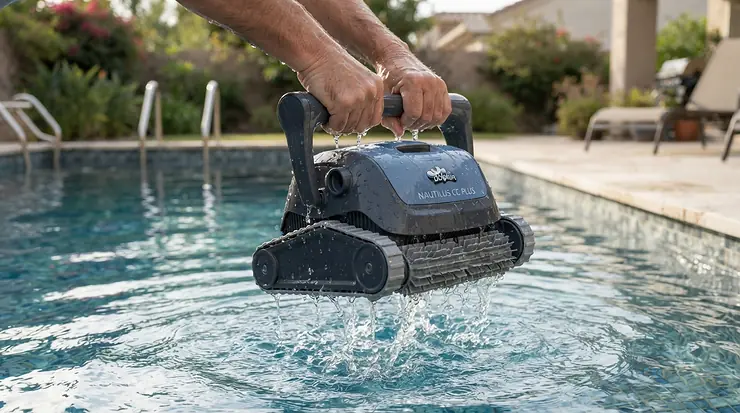
7. Dolphin Nautilus CC — the budget-minded top load workhorse
Not flashy, not fragile.
It offers a top load filter basket, wall climbing, active scrubbing and plug-and-play setup for pools up to 33 feet. Corded power means no battery to age out. One roundup says this top-loading design is the one pool owners most often recommend in forum threads about heavy leaf drop. The practical meaning: you lift the basket out, dump, rinse and go.
Here’s my honest analysis. For smaller pools and moderate leaf fall it’s a very sensible machine. For monster autumns you’ll likely empty it more often than you would a 5L or 6L rival, because its suction and basket figures weren’t clearly published in the sources I found.
Multiple editorial roundups pick it for simplicity and reliability. I couldn’t verify aggregated owner ratings.
Pros:
- ✅ Top-loading basket rinses in seconds
- ✅ Wall climbing and active scrubbing
- ✅ Plug-and-play setup
Cons:
- ❌ Expect more frequent emptying in heavy drops
- ❌ Cord management on larger pools
I couldn’t confirm a consistent price, but it’s generally the more accessible option here, so check current price. The value verdict: great for modest leaf loads on a budget.
Side-by-Side Specs and Value
| Pick | Suction Power (maker-stated) | Debris Holder | Price Range | Best For |
|---|---|---|---|---|
| Dolphin Premier | 4,500+ GPH | Oversized leaf bag | Check current price | Leaf-heavy yards |
| Dolphin Escape | Dual motors, GPH not published | Oversized top load filter basket | $1,500–$2,000 | Easy dumping |
| Dolphin Sigma | Triple commercial motors | Top-access fine filter kit | $1,400–$1,700 | Large pools |
| Beatbot Sora 70 | 6,800 GPH | 6L basket | Check current price | Worst-case leaves |
| Beatbot Sora 30 | 6,800 GPH | 5L basket | Check current price | Cordless value |
| Aiper Scuba V3 | 4,800 GPH | Multi-layer MicroMesh | ~€900–€1,300 (EU) | Light lifting |
| Dolphin Nautilus CC | GPH not published | Top load filter basket | Check current price | Smaller budgets |
The table makes one thing obvious: the Beatbot Sora 70 and Beatbot Sora 30 lead on published suction and basket numbers, while the Dolphin models counter with filter-design flexibility, such as the Dolphin Premier leaf bag. The Dolphin Sigma is the pick when pool size, not just debris, drives your decision. The Dolphin Nautilus CC and Aiper Scuba V3 trade raw capacity for simplicity and weight.
Your First 30 Days: Setup and Leaf-Season Routine
Setup is plug-and-play on most of these, but leaf season rewards a little discipline.
Before the first run, skim off floating mats by hand, since robots work the floor and walls better than a thick surface layer. Keep the power supply in a dry, shaded spot, because overheating can cause shutdowns. Check that your outlet is GFCI-protected (more on that in the safety section).
Then build a rhythm. Many retailers suggest running a robot two to three times a week in peak season and about once a week off-season. In leaf drop, lean toward the higher end. Leaves fill baskets long before they drain a battery, so short, frequent cycles beat one heroic run.
Rinse the basket after every cycle, not every other one. Check brushes and tracks for wrapped debris weekly. Rotate or replace filters on schedule.
The classic first-month mistakes? Letting the basket overflow, parking the robot in direct sun, and ignoring twig tangles around the brushes. Fix those three and most “my robot doesn’t work” complaints vanish.
Real-World Scenarios: Matching a Robot to Your Yard
Specs are abstract. Yards are not. Here are three profiles with honest reasoning.
The oak-canopy suburban pool. Imagine a 30-by-15-foot in-ground pool under three large oaks, cleaned mostly on weekends. Constant bulk leaves argue for the Dolphin Premier and its leaf bag, or the Beatbot Sora 30 if you prefer cordless and a 5L basket. Run it three times a week in October and November.
The big pool with pines and storms. Picture a 40-foot pool, deep pockets and frequent post-storm debris. The Dolphin Sigma suits large layouts with its 50-foot rating and 60-foot cable. The Beatbot Sora 70 is the alternative if surface skimming and a 6L basket appeal more, provided you plan shorter cordless cycles.
The small above-ground pool on a budget. Think of an 18-foot above-ground pool with moderate leaf fall and a tight budget. The Dolphin Nautilus CC covers pools up to 33 feet with a top-loading basket you can rinse in seconds. If lifting is your pain point, the roughly 18-pound Aiper Scuba V3 is easier on wrists and backs.
The thread connecting all three: match capacity to cleaning frequency, not just to pool size. A 30-foot pool with weekly cleaning needs a bigger basket than a 30-foot pool cleaned every other day.
Problem → Solution Guide: When the Leaves Still Win
Even great robots hit snags. Here’s how to troubleshoot the five most common ones.
1. The robot quits mid-pool. The basket is probably full. Empty it more often, or split cycles into two shorter runs. A bigger basket like the Beatbot Sora 70‘s 6L design postpones the problem.
2. Leaves are still floating after a cycle. Most robots work floors and walls. Skim first, or consider a surface-capable model such as the Beatbot Sora 70.
3. Suction seems weak. Wet leaves can plaster against filters and reduce flow. Rinse thoroughly, and for heavy leaves favor coarse filtration, like the Dolphin Premier‘s leaf bag, over fine media.
4. Twigs jam brushes or the intake. Clear the intake and brushes by hand, and pick out large branches before the run. A wider intake and strong tracks, as on the Dolphin Escape, help.
5. A cordless battery fades early. Use shorter, more frequent runs, or choose a corded model like the Dolphin Sigma for very large pools.
✨ Don’t Miss These Exclusive Deals!
🔍 Take your leaf-season routine to the next level with these carefully selected robots. Click any highlighted product name to check current pricing and availability. The right machine will help you reclaim a clean, swim-ready pool this autumn!
How to Choose a Robotic Pool Cleaner for Pools With Heavy Leaf Debris
Follow these seven steps and you’ll skip most of the regret.
- Start with debris capacity. Beatbot’s buying guide (a manufacturer source, so weigh it accordingly) notes a larger basket makes each cycle more productive during leaf season. For large pools, aim for 4L or more.
- Check suction power, then check it against the basket. Strong motors are useless once the basket is full.
- Pick the filter design. A top load filter basket dumps cleanly, while bags favor flow. We’ll compare them next.
- Match filtration to your debris. Leaves want coarse filtering and sand wants fine. One guide suggests a roughly 4L basket with a 180-micron filter can handle both.
- Choose corded or cordless. Corded avoids battery aging, while cordless avoids cable wrestling.
- Inspect the intake and traction. A narrow intake chokes on leaves. Tracks help on slick surfaces.
- Consider surface cleaning and warranty. Floating leaves need surface skimming, and a long warranty protects a four-figure investment.
Top Load Filter Basket vs Leaf Bag: Which Design Handles Heavy Leaves Better?
This is the quiet fight that decides your Sunday afternoons.
A robotic pool cleaner with large top load basket is hard to beat on convenience. You lift it out, tip it, rinse it and slide it back. There’s no mesh sock to wrestle, and a rigid basket keeps its shape under a load of wet debris. A top load filter basket also tends to show you what’s inside, which helps you judge when to empty it.
A leaf bag, like the one on the Dolphin Premier, flips the trade-off. Coarse mesh lets water rush through even when the bag is loaded with leaves, which protects suction power late in the cycle. The price is a different handling routine.
Forbes’ 2026 roundup quotes a pool maintenance expert who recommends a debris canister or coarse bag for leaves and twigs, and an ultra-fine filter for algae and sand. That lines up with my analysis. For pure leaf duty, coarse wins. For mixed duty, a basket with swappable fine inserts, like the Aiper Scuba V3‘s multi-layer setup, gives you flexibility.
Suction Power: What the GPH Numbers Really Tell You
Suction power is the number everybody quotes and few people interpret.
One buying guide says many robots struggle with wet leaves and acorns below about 4,000 GPH, and a comparison review reports that a 1,200 GPH model left leaves floating after cleaning. Both are directional sentiments, not lab results. That makes the Aiper Scuba V3 at 4,800 GPH, the Dolphin Premier at 4,500+ GPH and both Beatbot models at 6,800 GPH comfortable on paper.
Here’s the catch: manufacturers don’t measure GPH identically, so comparing a Beatbot Sora 70 figure with a Dolphin Premier figure is more of a rough guide than a race result. More importantly, suction power is only half the equation. A powerful motor with a small basket stops being useful the moment that basket fills, and leaves fill baskets before they exhaust batteries. Treat GPH as a minimum bar, then let basket design and intake width break the tie.

Debris Capacity: How Big Is Big Enough?
Debris capacity is where leaf-heavy pools win or lose.
Published basket sizes give a feel for the range. Beatbot lists 3.7L, 4L and 5L baskets across its AquaSense line, 5L for the Beatbot Sora 30 and 6L for the Beatbot Sora 70. The Dolphin models mostly describe their capacity qualitatively. The Dolphin Escape is “oversized” and the Dolphin Premier has an “oversized leaf bag,” without liter figures I could verify.
A useful rule of thumb: aim for a basket that can swallow a typical week’s debris, not just a single lap. Leaves are voluminous but light, which means volume fills long before weight becomes an issue. Wet leaves, acorns and twigs, however, add real heft, so weight matters when you lift it out.
If you’re torn between two models, the larger basket usually wins for heavy leaf pools, unless lifting weight is your constraint, in which case the lighter Aiper Scuba V3 earns a second look. Capacity numbers are also the least standardized spec in this category, so compare like with like.
Pool Robot for Leaves and Twigs: Handling Branches, Acorns and Pine Needles
A pool robot for leaves and twigs faces three distinct enemies.
Leaves are the easy ones. They fold, flex and slip into baskets. Twigs and acorns are rigid and bulky. They need a wide intake and strong suction power, and they can jam brushes. Beatbot’s own guidance lists inlet width as one of four key factors, alongside basket capacity, suction and surface cleaning.
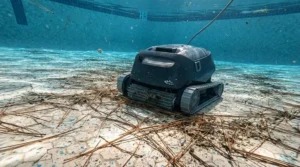
Pine needles are the sneaky ones. They’re thin enough to slip through coarse filtration, so a combination of a coarse outer basket and a fine insert tends to work best. That’s my reasoning from how filters work rather than a tested claim.
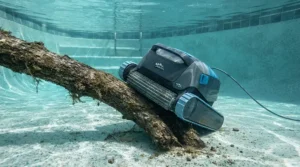
Practically speaking, a pool robot for leaves and twigs won’t replace you for the very largest branches. Pick those out by hand before a run, and your robot’s tracks, brushes and intake will thank you. If branches and acorns dominate, favor strong tracks and a wide intake, which makes the Dolphin Escape and Beatbot Sora 70 logical shortlist items.
Robotic Pool Cleaner vs Pressure-Side and Suction-Side Cleaners
Not sure a robot is worth it versus the older cleaner types? Here’s how they compare for leaf-heavy pools.
| Cleaner Type | Debris Handling | Effort Level | Upfront Cost | Best For |
|---|---|---|---|---|
| Robotic | Own canister, independent of your pump | Lowest | Highest | Frequent leaf fall, e.g. Dolphin Premier, Beatbot Sora 70 |
| Pressure-side | Better bulk handling than suction-side | May need extra equipment | Mid | Mixed debris, larger leaves |
| Suction-side | Relies on pool circulation | Needs filter attention | Lowest | Light debris |
Robotic cleaners collect debris in their own canister, which takes pressure off your skimmer basket and main filter. That matters in a leaf-heavy pool, because you aren’t pushing every leaf through your circulation system. Pressure-side cleaners handle larger leaves better than suction-side models but typically need extra oversight.
For heavy leaf fall, robots usually deliver the best long-term fit, as one pool-care guide puts it, even though they cost more upfront. If your budget is tight and leaves are modest, a Dolphin Nautilus CC narrows the gap.
Long-Term Cost and Maintenance
The sticker price is only chapter one.
Think in terms of total cost of ownership. Warranty length is your first lever. The Dolphin Sigma carries three years, which matters because motors and electronics are what fail. Consumables come next: brushes, tracks and filters wear, particularly with abrasive debris like sand and acorns. Rinse after every cycle and store the robot out of direct sun to extend its life.
Cordless models like the Beatbot Sora 70, Beatbot Sora 30 and Aiper Scuba V3 carry battery aging, a cost corded models like the Dolphin Nautilus CC and Dolphin Escape sidestep. Corded designs can also run as long as needed, with cable routing as the practical limit.
Energy use is low across the category, so electricity rarely tips the scales. What does matter is your time. A robot that needs emptying mid-cycle costs you time every single leaf-season week. That’s why paying more for debris capacity often pencils out better than saving on the purchase and paying in weekends.
Electrical Safety: What to Check Before You Plug In
Water and electricity are a bad mix, so treat this section as non-negotiable.
The U.S. Consumer Product Safety Commission recommends ground-fault circuit interrupters (GFCIs) as the most effective protection against shock around pools, as outlined in its Don’t Swim With Shocks advisory. Electrical code summaries also require GFCI protection on common receptacles within 20 feet of a pool.
In practice: plug any corded robot’s power supply into a GFCI outlet, keep it as far from the water’s edge as your cable allows, and test the GFCI monthly. Look for UL-listed equipment and follow your owner’s manual on power-supply placement. If you’re adding or moving an outlet, hire a licensed electrician rather than improvising.
Cordless models reduce the cord hazard, but they still involve a charger, so keep it dry and indoors or sheltered. Safety isn’t glamorous, but it’s the one section of this article I’d never skip.
FAQ
❓ Can a robotic pool cleaner handle wet leaves without clogging?
❓ How often should I run a pool robot during leaf season?
❓ Is a corded or cordless robot better for large leafy pools?
❓ Will a robot replace my skimmer and main filter?
❓ Should I skim floating leaves before running the robot?
Conclusion
Choosing the right robotic pool cleaner for pools with heavy leaf debris comes down to three things: suction power, debris capacity and how easily you can empty the thing. Here’s the short version.
Pick the Dolphin Premier for pure leaf muscle and flexible filtration. Choose the Beatbot Sora 70 for the biggest basket plus surface skimming. Go for the Dolphin Escape if a large, easy-dump top load filter basket is your dream. The Dolphin Sigma is the premium choice for big pools. For value, look at the Beatbot Sora 30, the lightweight Aiper Scuba V3 and the budget-friendly Dolphin Nautilus CC.
Whatever you choose, match capacity to your cleaning frequency, keep it on a GFCI outlet and rinse the basket after every cycle. Do that, and leaf season stops being a battle and becomes a background task.
Recommended for You
- Cordless vs Corded Robotic Pool Cleaner for Large Inground Pools 2026
- Cordless Robotic Pool Cleaner for Above Ground Pool Ladder Entry 2026
- Robotic Pool Cleaner for Pets with Hair in the Pool: 7 Best Buys 2026
Disclaimer: This article contains affiliate links. As an Amazon Associate, I earn from qualifying purchases. If you purchase products through these links, we may earn a small commission at no additional cost to you.
✨ Found this helpful? Share it with your friends! 💬🤗
